Understanding the V8 Sandbox: A New Step Toward Memory Safety
After nearly three years of development, the V8 Sandbox—a lightweight, in-process sandbox for the V8 JavaScript engine—has moved beyond its experimental phase. Its inclusion in Chrome's Vulnerability Reward Program (VRP) marks a key milestone, even though the sandbox is not yet a fully hardened security boundary. Chrome 123 serves as a beta release for this feature. This Q&A explores the motivation behind the sandbox, how it thwarts memory corruption, and why existing safety approaches fall short for V8's unique challenges.
What is the V8 Sandbox and why was it created?
The V8 Sandbox is an in-process security mechanism designed to limit the impact of memory corruption vulnerabilities within the V8 JavaScript engine. Created by Chrome's security team, it aims to prevent an attacker from exploiting a V8 bug to gain full control over the host process. The sandbox was motivated by the finding that over 60% of Chrome exploits uncovered in the wild between 2021 and 2023 originated from V8 vulnerabilities. Unlike traditional memory safety bugs, V8 flaws are often subtle logic errors that can be leveraged to corrupt memory, making specialized defenses essential.
Why are existing memory safety solutions not effective for V8?
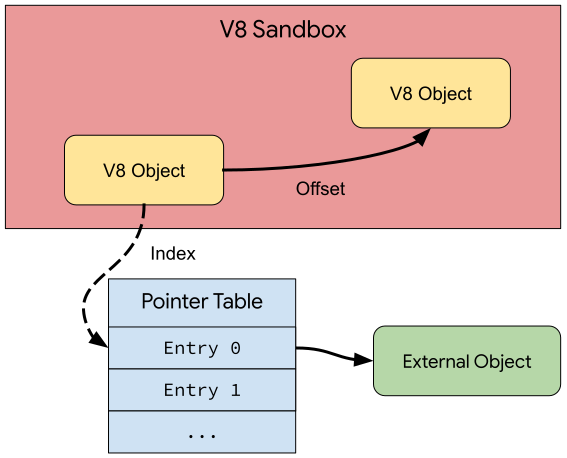
Common approaches like rewriting in Rust or using hardware memory tagging (e.g., ARM MTE) aren't suited for V8's core problem. V8 vulnerabilities rarely involve classic buffer overflows or use-after-frees; instead, they are logic bugs that let attackers bypass safety checks. For instance, a call to ToNumber() in a JavaScript engine can trigger user-defined callbacks, which may alter the array length and cause out-of-bounds writes. Rust's ownership model can't prevent such side-effect-driven corruption, and memory tagging only catches low-level memory misuse. The V8 Sandbox addresses these issues by isolating V8's internal heaps and code regions within the host process, creating a bounded environment where corruption cannot easily escape.
Can you explain the type of vulnerability that the V8 Sandbox addresses?
A classic example is a bug in a hypothetical JSArray::fizzbuzz function. The function iterates over an array, converting each value to a number. During conversion, a JavaScript callback can modify the array (e.g., shrink it). After the callback returns, the loop continues writing to positions that no longer exist, causing out-of-bounds memory access. This is not a simple buffer overflow but a logic flaw where side effects break the engine's assumptions. The V8 Sandbox contains such corruption by limiting which memory regions can be accessed, preventing the attacker from corrupting data outside V8's isolated zone.
What does the inclusion in Chrome's VRP mean for the Sandbox?
Inclusion in the Vulnerability Reward Program signals that Chrome considers the V8 Sandbox a meaningful security improvement. Researchers can now submit reports of sandbox bypasses for rewards, which will help identify remaining weaknesses. According to the Chrome team, this step is important for maturing the sandbox into a stronger boundary. Chrome 123 is described as a beta release: the sandbox is active and beneficial, but not yet hardened enough to be a full security guarantee. The VRP encourages community testing and will accelerate the resolution of issues before the sandbox becomes a default enforcement layer.
How does the V8 Sandbox prevent memory corruption from spreading?
The sandbox operates as a lightweight, in-process isolation layer. It restricts V8's memory accesses to a designated region—often called the sandbox heap—separate from the rest of the host process. Even if an attacker corrupts memory within V8 (e.g., via an out-of-bounds write), the sandbox prevents them from overwriting critical data outside that region, such as renderer process metadata or browser kernel structures. The design uses hardware and software guards to enforce bounds on pointers and allocations. While not yet a complete isolation mechanism, it significantly raises the bar: an attacker who exploits a V8 bug must first find a way to escape the sandbox to achieve full remote code execution.
What are the remaining challenges before the V8 Sandbox becomes a strong security boundary?
Several issues remain on the roadmap. The sandbox currently does not cover all V8 internal objects and code paths; some legacy features may still allow memory corruption to leak out. Performance overhead must be minimized to avoid degrading user experience. Additionally, the sandbox's security guarantees rely on the correctness of its own isolation primitives, which require rigorous verification. The Chrome team intends to address these through continued development, fuzzing, and VRP-driven discoveries. Once these hurdles are overcome, the sandbox will become a robust security boundary, potentially combined with other measures like control-flow integrity and sandboxing at the operating system level.
Related Articles
- Partial Fix for 'Dirty Frag' Vulnerability Rolls Out in New Stable Kernel Releases
- 7 Critical Insights into Kimsuky’s Evolving PebbleDash Campaigns
- Cybersecurity Legends Revisit 20 Years of Predictions: What They Got Right
- Unlocking the Frozen Past: DNA Reveals Four More Franklin Expedition Crew
- 5 Critical Lessons from the 2026 Hypersonic Supply Chain Attacks
- Turla Upgrades Kazuar Backdoor into Stealthy Modular P2P Botnet for Long-Term Access
- DIY Enthusiast Transforms VTech Toddler Toy into Fully Functional Linux Laptop: The PinkPad V1
- 10 Fascinating Facts About How Neurons Overcome Protein Transport Challenges for Synaptic Communication