Safeguarding Configuration Rollouts at Meta: Canary Deployments and AI-Driven Monitoring
Introduction
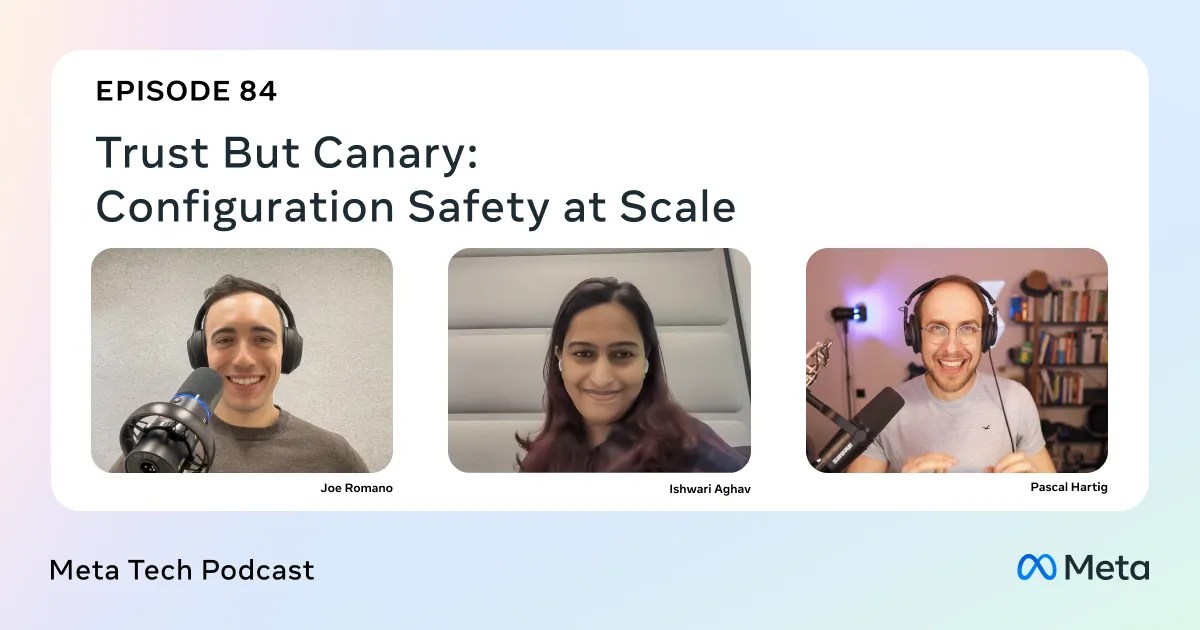
As artificial intelligence accelerates developer speed and productivity, the need for robust safeguards becomes paramount. Meta's Configurations team is at the forefront of ensuring that configuration changes are rolled out safely at scale. In a recent discussion on the Meta Tech Podcast, Pascal Hartig spoke with Ishwari and Joe from the team about the strategies and tools that keep Meta's production environment stable. This article explores the key takeaways, including canary deployments, progressive rollouts, health checks, monitoring signals, incident reviews, and how AI and machine learning are reducing alert noise and speeding up debugging.
Canary Deployments and Progressive Rollouts
One of the fundamental practices for safe configuration changes is the use of canary deployments. Instead of pushing a new configuration to all users at once, Meta rolls it out to a small subset first—the "canary." This allows the team to observe real-world behavior and catch regressions early. If the canary indicates issues, the rollout can be halted or rolled back before it affects a larger audience.
Health Checks and Monitoring Signals
To detect regressions promptly, Meta employs a suite of health checks and monitoring signals. These signals track metrics such as error rates, latency, and resource usage. By comparing canary metrics against baseline values, the team can automatically identify anomalies. This automated feedback loop is crucial for maintaining confidence in the rollout process.
Learning from Incidents: A Blameless Culture
Despite best efforts, incidents can still occur. Meta's approach to incident reviews focuses on improving systems rather than blaming people. The team conducts thorough post-incident analyses that examine the entire configuration pipeline—from the initial change to the detection and mitigation steps. By treating each incident as an opportunity to strengthen safeguards, the organization fosters a culture of continuous improvement.
Incident Review Process
Each review identifies contributing factors and suggests concrete improvements. These may include adding new monitoring signals, refining canary criteria, or enhancing automation. The process also encourages sharing lessons across teams, ensuring that the same mistakes are not repeated.
The Role of AI and Machine Learning
Data and AI/machine learning are playing an increasingly vital role in configuration safety. Two key areas where ML makes a difference are reducing alert noise and speeding up bisecting.

Reducing Alert Noise
Teams often struggle with an overwhelming number of alerts, many of which are false positives. Meta uses ML models to filter and prioritize alerts. By learning from historical incident data, the models can distinguish between genuine issues and routine fluctuations. This allows engineers to focus on actionable alerts rather than drowning in noise.
Speeding Up Bisecting
When an incident does occur, identifying the root cause quickly is critical. Bisecting involves testing different configuration versions to pinpoint the change that introduced the problem. Machine learning accelerates this process by analyzing patterns across multiple signals and suggesting the most likely candidates. This reduces the time needed to restore service.
Conclusion
Meta's Configurations team demonstrates that safe, large-scale configuration rollouts are achievable through a combination of careful deployment strategies, robust monitoring, a blameless incident review culture, and the intelligent use of AI. As development speed increases with AI assistance, these practices become even more essential for maintaining reliability and trust. The lessons from Meta's approach are valuable for any organization seeking to balance innovation with safety.
For more insights, listen to the full episode on the Meta Tech Podcast, available on Spotify, Apple Podcasts, or Pocket Casts. Follow Meta Engineering on Instagram, Threads, or X for updates.
Related Articles
- How to Optimize Go Performance with Stack Allocation for Slices
- Mastering Python Project Structures: A Comprehensive Reference
- Automating Coding Agent Analysis with GitHub Copilot: A Step-by-Step Guide
- New VS Code Python Extension: Smarter Symbol Search and Faster Indexing
- Microsoft Abandons SMS Authentication for Personal Accounts, Mandates Passkeys
- Navigating API Violations and Hyrum's Law: A Kernel Developer's Guide to Restartable Sequences and TCMalloc
- Designing Imaging Systems by Measuring Information Content
- Python 3.15.0 Alpha 1: A Developer Preview Guide