TurboQuant: Google’s Breakthrough in KV Cache Compression for LLMs and RAG
Introduction
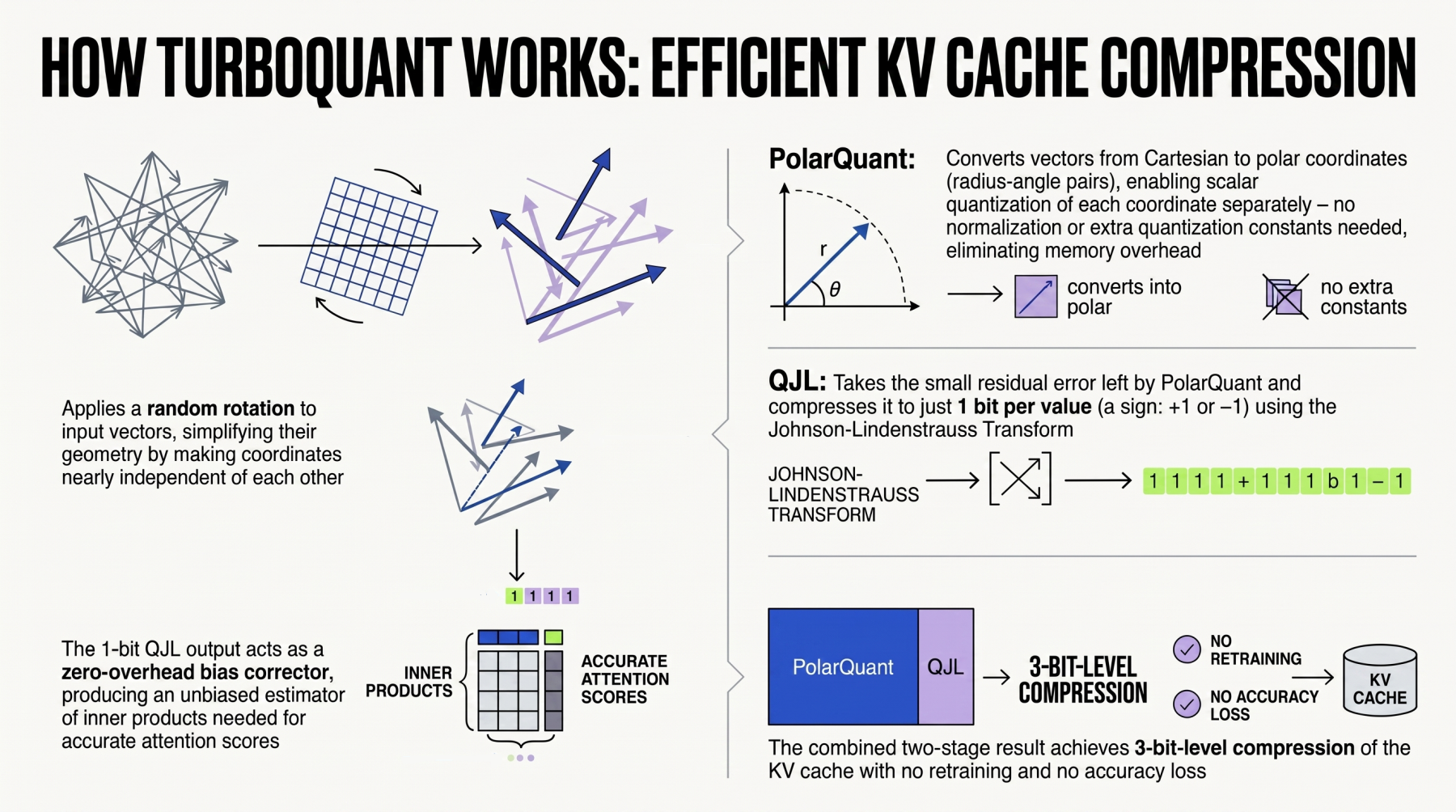
Large language models (LLMs) have revolutionized natural language processing, but their deployment in real-world applications faces significant memory bottlenecks. One of the most critical memory consumers is the key-value (KV) cache, which stores intermediate attention states during inference. Compressing this cache without sacrificing accuracy is a major challenge. Google has recently introduced TurboQuant, a novel algorithmic suite and library specifically designed to apply advanced quantization and compression to LLMs and vector search engines—a cornerstone of retrieval-augmented generation (RAG) systems. This article explores how TurboQuant achieves effective KV compression and why it matters for modern AI pipelines.
Understanding KV Cache Compression
In transformer-based models, the KV cache holds the keys and values of all previous tokens to enable efficient autoregressive decoding. However, as sequence length and batch size grow, this cache can consume gigabytes of GPU memory. Compression techniques aim to reduce the memory footprint by lowering the precision of stored values (quantization) or by pruning redundant entries. The challenge lies in maintaining model quality while aggressively compressing—a balance that TurboQuant addresses with its sophisticated algorithms.
Why Compression Matters for RAG
Retrieval-augmented generation systems rely on vector search engines to fetch relevant documents, which are then fed into an LLM. Both the search index and the KV cache benefit from compression: smaller indices mean faster search, and smaller caches allow larger context windows. TurboQuant targets both sides, making it an indispensable tool for building scalable RAG applications.
TurboQuant: Google’s Solution
TurboQuant is not just a single algorithm but a suite of quantization and compression techniques optimized for modern hardware. According to Google’s announcement, it achieves state-of-the-art memory reduction with minimal accuracy loss. Key elements include:
- Adaptive quantization: Dynamically selects precision levels (e.g., int4, int8) per layer or even per token, based on sensitivity.
- Structured pruning: Eliminates redundant KV pairs without degrading attention quality.
- Hardware-aware optimizations: Tailors compression kernels to GPUs and TPUs for maximum throughput.
The library is designed to be plug-and-play, integrating seamlessly with popular LLM frameworks like TensorFlow, PyTorch, and JAX.
Key Features and Benefits
Memory Reduction
TurboQuant can compress the KV cache by 4x to 8x compared to standard float16 storage, depending on the model and quality requirements. For example, a 70B parameter LLM with a 32k token context can see its cache drop from over 10 GB to less than 3 GB.
Speed Gains
Smaller caches mean lower memory bandwidth pressure, leading to faster decoding. Early benchmarks show up to 2x throughput improvement on long-context tasks, making TurboQuant ideal for real-time applications like chatbots or document assistants.
Accuracy Preservation
Unlike naive quantization that can cause perplexity spikes, TurboQuant employs fine-grained calibration and regularization to keep perplexity degradation below 0.5% on most benchmarks (e.g., Wikitext, Lambada).
Impact on RAG Systems
In RAG pipelines, vector search engines (e.g., Google’s ScaNN or Facebook’s FAISS) also benefit from TurboQuant’s compression. By quantizing vector embeddings from float32 to int8 or even int4, retrieval latency can drop by 30-50% while maintaining >98% recall. Combined with LLM-side KV compression, the entire system becomes more cost-effective and scalable.
For example, a production RAG service serving thousands of queries per second could reduce its GPU memory requirements by half, allowing more simultaneous users or smaller deployment clusters.
Implementation Considerations
Deploying TurboQuant requires minimal code changes. Developers can either use the provided Python API or call the library’s C++ kernels directly for low-level control. The suite supports both offline (post-training) compression and online (during inference) dynamic quantization. Google has also released sample integrations for popular model zoos like Hugging Face Transformers.
However, users should note that aggressive compression may slightly increase output variability in creative tasks. The recommended approach is to start with conservative settings (e.g., int8) and gradually tune down precision based on application tolerance.
Conclusion
TurboQuant marks a significant step forward in making LLMs and RAG systems more memory-efficient and faster. By compressing KV caches and vector embeddings without compromising quality, Google’s suite unlocks new possibilities for deploying large models at scale. As AI continues to grow, tools like TurboQuant will be essential for democratizing access to high-performance inference. For developers and researchers alike, exploring TurboQuant’s capabilities can lead to dramatic resource savings and improved user experiences.
To learn more about quantization techniques, see our article on Understanding KV Cache Compression or explore the Key Features section above.
Related Articles
- How GitHub’s New Accessibility Agent Streamlines Inclusive Design
- From Data to Discovery: A Step-by-Step Guide to Turning Information into Insights
- Week of May 11 Threat Intelligence: A Practical Guide to Analyzing and Responding to Recent Cyber Incidents
- Mastering FreeCAD 1.1: A Beginner's Guide to Part Design with Clear Instructions
- EVM Demystified: The Key to Optimizing Next-Generation Wireless Performance
- Kazakhstan's Ministry Renews Coursera Partnership to Advance Digital and AI Education for Students
- AWS Launches Free AI Education Program for 100,000 Learners Worldwide
- Mastering Markdown: A Beginner's Q&A Guide