7 Critical Lessons from the CPU-Z Watering Hole Attack: How AI EDR Stopped a Supply Chain Breach
On April 9, 2026, a sophisticated supply chain attack compromised the official CPUID website, silently serving malware through the legitimate download button for nearly 19 hours. Threat actors had infiltrated the API layer, redirecting users to attacker-controlled servers. This event underscores a new era of trust exploitation. Below are seven key insights from the incident, illustrating how SentinelOne’s autonomous AI EDR detected and blocked the threat in seconds.
1. The Attack Vector: API-Level Compromise
The attackers did not deface the site or replace binaries; they hijacked the API layer of cpuid.com. When users clicked the official download button, the API silently redirected the request to an attacker-controlled server. This server delivered a legitimate, digitally signed copy of CPU-Z bundled with a malicious payload. The compromise lasted 19 hours, and during that window, anyone downloading directly from the vendor’s site received the trojanized software.

2. The Deceptive Trust Chain
Users and security tools typically trust software that is digitally signed and delivered from the vendor’s own domain. In this attack, the binary was genuine, the signature valid, and the infrastructure apparently clean. The trust chain—developer, code signing, distribution—appeared intact. Yet the trust was subverted at the API level. This demonstrates that classic trust indicators (signatures, domain reputation) are no longer sufficient when the supplier’s infrastructure itself becomes the delivery channel.
3. Behavioral Anomalies: The Process Chain Tells the Story
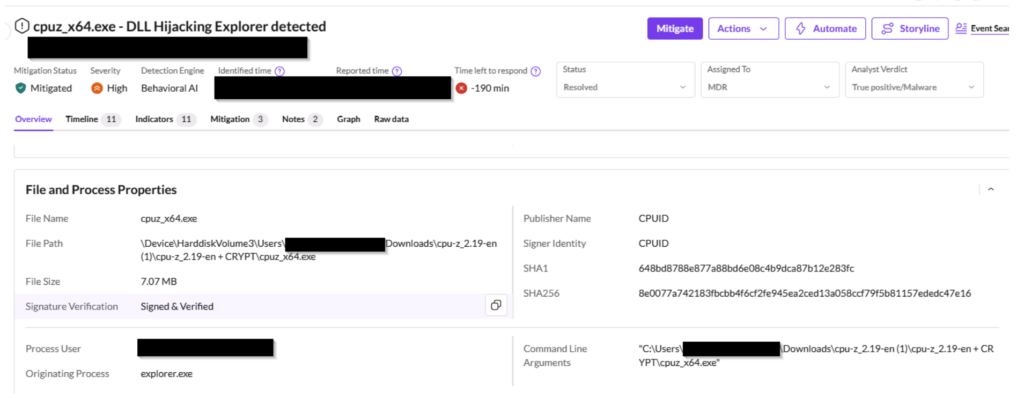
SentinelOne’s behavioral analysis flagged the execution of cpuz_x64.exe within seconds. The real CPU-Z binary does not spawn PowerShell, then csc.exe (C# compiler), then cvtres.exe (resource compiler). That process chain was the first indicator of compromise. The legitimate binary was being used as a launching pad for malicious code. Such deviations from expected behavior are impossible for signature-based tools to catch, but AI-driven EDR sees them instantly.
4. A Systemic Shift in Supply Chain Attacks
This incident is part of a broader trend identified in SentinelOne’s Annual Threat Report: attackers now target the identity of trusted developers rather than breaking into systems directly. In late 2025, the GhostAction campaign used a compromised GitHub maintainer account to push malicious code. A concurrent phishing attack on an NPM package maintainer injected cryptocurrency-stealing malware. In both cases, commit logs appeared legitimate because the accounts had valid write access. The CPUID attack extends this pattern to software distribution: the supplier’s own download infrastructure became the weapon.
5. Five Behavioral Indicators That Triggered the Alert
The SentinelOne agent raised a “Penetration framework or shellcode detected” alert based on five converging indicators:
- Anomalous API resolution: The process bypassed the OS loader, locating system functions through non-standard methods.
- Reflective code loading: Executable code ran in memory without a corresponding file on disk.
- Suspicious memory allocation: Read-Write-Execute (RWX) permissions were requested, a classic staging pattern for payloads.
- Process injection patterns: Execution flow indicated code redirection into a secondary process to hide its origin.
- Heuristic shellcode signatures: Sequential operations typical of exploitation toolkits preparing for command execution.
These indicators, combined, gave the agent high confidence to act autonomously.
6. Autonomous Response: No Human Intervention Needed
Within seconds of detection, the SentinelOne agent terminated and quarantined the involved processes. The attack never progressed beyond the initial execution stage. The malicious CRYPTBASE.dll file, placed in the installation directory, was prevented from executing further. This rapid, autonomous response is critical because supply chain attacks often involve zero-day or heavily obfuscated payloads that outpace traditional signature updates and manual analysis.
7. Lessons for Defenders: Trust but Verify—and Monitor Behavior
The CPU-Z incident teaches that even verified identities and signed binaries can be weaponized. Organizations must shift from static trust models to dynamic behavioral monitoring. An agent that watches what processes do—not just who signed them—can catch malicious activity even when the source is legitimate. The next attack will work the same way: exploiting the broken trust chain above the user. Prepare now by deploying AI-driven endpoint detection that acts on behavior, not reputation.
As supply chain attacks grow more sophisticated, the ability to detect and respond autonomously is no longer a luxury—it is a necessity. SentinelOne’s AI EDR proved that even when the trust chain fails, behavioral analysis can stop the attack in its tracks. The CPU-Z watering hole is a wake-up call for every organization relying on third-party software. Review your defenses. Ensure your detection tooling looks beyond signatures and into the runtime behavior of every process.
Related Articles
- Mastering the Linux Kernel Crypto Bug Exploit: A Practical Guide for System Administrators
- Iran-Linked Group Claims Destructive Cyberattack on Medical Device Maker Stryker
- Emergency Alert: Microsoft Exchange Zero-Day Under Active Attack – Patch Not Yet Available
- Vidar Stealer Surges: How ClickFix Social Engineering Targets Australian Networks
- 10 Key Insights into Mobile Threat Evolution in Q1 2026
- Zero-Trust Network Simulation with Adaptive Policies and Insider Threat Detection: A Q&A Guide
- Securing Your Software Supply Chain: Lessons from the Checkmarx and Bitwarden Attacks
- AI-Powered Exploits: The Zero-Day Window Shrinks as Machines Outpace Human Defenders