10 Key Optimizations That Doubled JSON.stringify Speed in V8
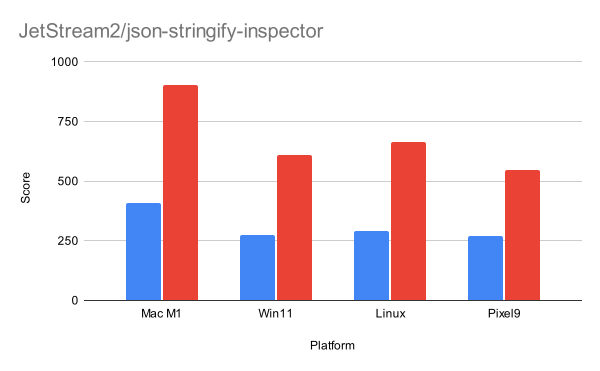
JSON.stringify is a workhorse in JavaScript, used everywhere from sending data to APIs to saving preferences in localStorage. Its speed directly impacts user experience. Recently, the V8 team achieved a remarkable improvement: making JSON.stringify more than twice as fast. This listicle breaks down the ten technical optimizations behind that achievement, offering a clear view of how modern JavaScript engines squeeze out every microsecond.
1. Side-Effect-Free Fast Path
The core optimization relies on detecting when serialization has no side effects. If an object doesn't trigger any user-defined code, property getters, or internal operations that might cause garbage collection (GC), V8 can use a streamlined, highly optimized path. This bypasses the expensive checks and defensive logic of the general-purpose serializer, resulting in significant speed gains for plain data objects.
2. Iterative Traversal Replaces Recursion
Instead of the traditional recursive approach, the new fast path uses iterative traversal. This eliminates stack overflow checks for deeply nested objects, allows quick resumption after encoding changes, and lets developers serialize much deeper structures than before—without hitting call-stack limits.
3. Templatized String Serialization
Strings in V8 can be one-byte (ASCII) or two-byte (non-ASCII). To avoid branching and type checks, the stringifier is now templatized on character type. Two distinct compiled versions exist: one optimized for one-byte, another for two-byte. This specialization reduces runtime decisions and speeds up serialization of common ASCII-heavy data.
4. Efficient Handling of Mixed Encodings
When strings contain both ASCII and non-ASCII characters, the serializer uses the two-byte template by default, ensuring correctness without penalizing pure one-byte cases. The check occurs during instance type inspection, which is necessary anyway, so overhead is minimal.
5. Avoiding Garbage Collection Triggers
Certain internal operations can trigger GC cycles during serialization, breaking the fast path. The optimization identifies these operations (like flattening a ConsString) and falls back to the slow path only when necessary. By avoiding GC on the fast path, performance remains predictable and swift.
6. ConsString and SlicedString Fallback Detection
Before accessing string data, V8 must check for representations like ConsString (concatenated strings) or SlicedString (substring views). These might require flattening, which can trigger GC. The fast path detects these early and defers to the general serializer, ensuring no side effects from GC while keeping the majority of simple strings fast.
7. Eliminating Stack Overflow Checks
By switching from recursion to iteration, the need for repeated stack overflow checks disappears. This not only reduces per-call overhead but also simplifies the code, making it easier for the compiler to optimize loops. The result is a more predictable and faster inner loop for serialization.
8. Optimizing Property Enumeration Order
V8 leverages known property layouts (like hidden classes) to enumerate properties in a fixed order, avoiding dynamic lookups. This is especially effective for objects created from JSON or via object literals, where shape is stable. The iteration uses direct slot access rather than generic property keys, cutting down descriptor lookups.
9. Micro-Optimizations in the Slow Path
Even the general-purpose path received targeted improvements, such as inlining common type checks and reducing the number of function calls per element. These changes compound, providing overall speed improvements even when the fast path cannot be applied.
10. Balancing Binary Size with Performance
Templatizing the stringifier increases code size because two versions must be stored. However, V8's team judged the performance benefit worth the trade-off. Similar decisions were made throughout: accepting moderate growth in binary size for significant runtime improvements. This pragmatic approach is key to modern engine design.
The combination of these optimizations—from the side-effect-free fast path to iterative traversal, templatized strings, and careful GC avoidance—has doubled JSON.stringify performance in practice. For developers, this means faster serialization of everyday JavaScript objects, leading to quicker network requests, smoother localStorage operations, and more responsive web applications. Future improvements may explore further specialization, but this milestone shows how deep, engine-level work can directly benefit the end user.
Related Articles
- The CSS ::nth-letter Selector: A Dream We Can Almost Touch
- React Native 0.80: Stabilizing the JavaScript API with Deprecations and New TypeScript Strictness
- Revolutionary Aluminum Compound: 7 Ways It Could Transform Industry and Replace Rare Metals
- GNU Compiler Collection 16.1: New Defaults and Experimental Frontiers
- 7 Key Optimizations That Made JSON.stringify Twice as Fast
- Block Protocol Ushers in New Era of Structured Web Data: Semantic Markup Finally Simplified
- 5 Key Mechanisms React Uses to Efficiently Detect UI Changes
- Monitoring AI Agents in Production with Grafana Cloud’s New Observability Features